个人简介
李乾,博士,中山大学中山医学院副教授,博士生导师,中山大学“逸仙学者计划” 新锐学者。2016年获得清华大学博士学位,随后在清华大学生命科学学院和IDG/麦戈文脑科学研究院从事博士后(2016-2018)及研究系列教师(2018-2024)工作,专注于学习、记忆和遗忘的神经生物学机制及相关疾病病理机制研究。长期致力于发现和理解生物脑为了更好地适应环境变化而具备的记忆管理(memory management)机制,包括用于对抗无关干扰的记忆主动保护机制(Neuron, 2018; eLife, 2023)和用于信息更新的记忆主动遗忘机制(Cell Reports, 2016; PNAS, 2019; Current Biology, 2025)。基于这些发现带来的新理解,也同时探索其在改善脑健康和干预脑疾病方面的潜在应用价值(Aging Cell, 2022; Current Biology, 2023)。目前已发表论文25篇,其中以第一或通讯作者(含共同)身份发表14篇,包括Neuron、PNAS(2篇)、Current Biology(2篇)、Cell Reports(2篇)、Aging Cell和eLife等国际知名期刊。
研究方向简介
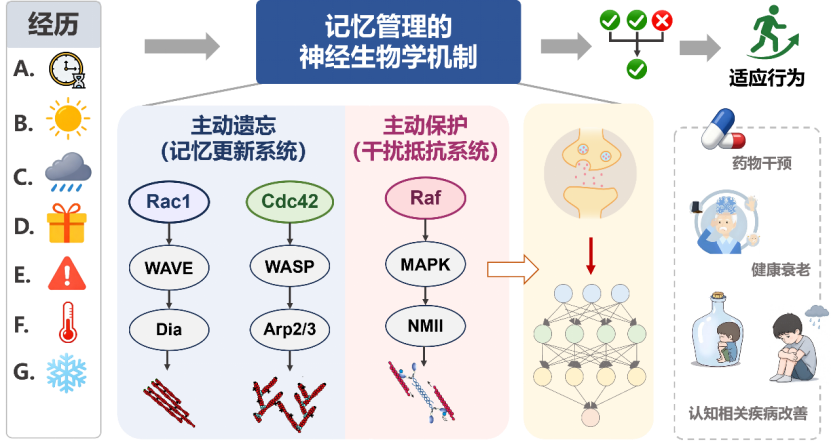
我们研究大脑如何管理记忆。记忆不只是被动记录过去,更重要的是预测未来、帮助我们适应环境变化。每天大脑都会形成很多记忆,但关键不是简单决定哪些记忆“存着”、哪些“删掉”,而是调节它们在需要时能否被顺利提取。有些记忆会被主动淡化,提取概率降低,不容易想起;有些记忆会被主动保护,提取概率提高,更容易被调用。这里的“遗忘”通常不是信息完全丢失,而是记忆变得不容易提取。
我们想回答:大脑如何决定哪些记忆更难提取、哪些更容易提取?哪些基因和神经机制在调控?这种调控异常会导致什么问题?有没有办法通过药物干预?我们利用动物模型,结合遗传学、药理学和行为学,寻找关键分子和神经机制,并开发小分子化合物,最终目标是理解记忆管理的底层神经生物学机制和寻求改善衰老、帕金森病、自闭症和抑郁症相关的认知损伤的干预方法。
主持科研项目
国家自然科学基金面上项目(32671377),2027-2030
国家自然科学基金专项项目(32541076),2026-2028
国家自然科学基金面上项目(31970955),2020-2023
国家自然科学基金青年科学基金项目(31700912),2018-2019
招生招聘
本课题组长期招收博士研究生、硕士研究生和博士后。除生物学相关研究背景以外,也欢迎有主动兴趣的不同学科背景人员加入团队。
招生专业:生物学、神经生物学、生物与医药
联系方式
liqian255@mail.sysu.edu.cn
主要论文发表情况(一作或通讯作者;时间倒序)
1)Wang, L.Y.*, and Li, Q.* (2025). Convergent multi-modular architecturefor adaptive learning in Drosophila and artificial intelligence. iScience 28, 113799.
https://www.sciencedirect.com/science/article/pii/S2589004225020607
2)Huang, N.#, Zhou, J.#, Gao, Y.#, Peng, Y.#, Hu, W., Ou, G., Li, Q.*, and Zhong, Y*. (2025). Rapid memory shift between different synaptic ensembles promotes forgetting in Drosophila. Current Biology 35, 3119-3132.e3114.
https://www.sciencedirect.com/science/article/pii/S0960982225006633
3)Zhao, J., Zhang, X., Zhao, B., Hu, W., Diao, T., Wang, L., Zhong, Y., and Li, Q*. (2023). Genetic dissection of mutual interference between two consecutive learning tasks in Drosophila. eLife 12.
https://elifesciences.org/articles/83516
4)Yang, Q.#, Zhou, J.#, Wang, L., Hu, W., Zhong, Y.*, and Li, Q.* (2023). Spontaneous recovery of reward memory through active forgetting of extinction memory. Current Biology 33, 838-848 e833.
https://www.cell.com/current-biology/fulltext/S0960-9822(23)00056-8
5)Zhao, B.#, Zhang, X.#, Zhao, J., and Li, Q*. (2022). Exclusion and Co-expression of Aversive Olfactory Long-Term Memories in Drosophila. Neuroscience Bulletin 38, 657-660. (cover)
https://link.springer.com/article/10.1007/s12264-022-00830-z
6)Mo, H.#, Wang, L.#, Chen, Y., Zhang, X., Huang, N., Liu, T., Hu, W., Zhong, Y., and Li, Q.* (2022). Age-related memory vulnerability to interfering stimuli is caused by gradual loss of MAPK-dependent protection in Drosophila. Aging Cell 21, e13628.
https://onlinelibrary.wiley.com/doi/10.1111/acel.13628
7)Liu, T.#, Wang, L.#, and Li, Q.* (2020). Drosophila Ortholog of Mammalian Immediate-Early Gene Npas4 is Specifically Responsive to Reversal Learning. Neuroscience Bulletin 37, 99-102.
https://link.springer.com/article/10.1007/s12264-020-00566-8
8)Wang, L.#, Yang, Q.#, Lu, B., Wang, L., Zhong, Y.*, and Li, Q.*(2019). A behavioral paradigm to study the persistence of reward memory extinction in Drosophila. Journal of Genetics and Genomics 46, 599-601.
https://www.jgenetgenomics.cn/en/article/doi/10.1016/j.jgg.2019.11.001
9)Gao, Y.#, Shuai, Y.#, Zhang, X.#, Peng, Y.#, Wang, L., He, J., Zhong, Y.*, and Li, Q.* (2019). Genetic dissection of active forgetting in labile and consolidated memories inDrosophila. Proceedings of the National Academy of Sciences of the United States of America 116, 21191-21197.
https://www.pnas.org/doi/10.1073/pnas.1903763116
10)Zhang, X.#, Li, Q.#, *, Wang, L., Liu, Z.J., and Zhong, Y. (2018). Active Protection: Learning-Activated Raf/MAPK Activity Protects Labile Memory from Rac1-Independent Forgetting. Neuron 98, 142-155 e144.
https://www.sciencedirect.com/science/article/pii/S0896627318301466
11)Hu, W.#, Peng, Y.#, Sun, J.#, Zhang, F., Zhang, X., Wang, L., Li, Q. *, and Zhong, Y*. (2018). Fan-Shaped Body Neurons in the Drosophila Brain Regulate Both Innate and Conditioned Nociceptive Avoidance. Cell Reports 24, 1573-1584.
https://www.sciencedirect.com/science/article/pii/S2211124718311185
12)Hu, W.#, Zhang, X.#, Wang, L., Liu, Z.J., Zhong, Y.*, and Li, Q.* (2017). Preferential distribution of nuclear MAPK signal in alpha/beta core neurons during long-term memory consolidation in Drosophila. Protein Cell 8, 780-783.
https://link.springer.com/article/10.1007/s13238-017-0404-8
13)Zhang, X.#, Li, Q.#, Wang, L., Liu, Z.-J., and Zhong, Y.* (2016). Cdc42-Dependent Forgetting Regulates Repetition Effect in Prolonging Memory Retention. Cell Reports 16, 817-825.
https://www.sciencedirect.com/science/article/pii/S2211124716307951
14)Li, Q.#, Zhang, X.#, Hu, W.#, Liang, X.#, Zhang, F., Wang, L., Liu, Z.-J., and Zhong, Y.* (2016). Importin-7 mediates memory consolidation through regulation of nuclear translocation of training-activated MAPK inDrosophila. Proceedings of the National Academy of Sciences of the United States of America113, 3072-3077.
https://www.pnas.org/doi/10.1073/pnas.1520401113
专著发表情况
1)Li, Q., and Zhong, Y. (2025). Remembering punishment-related odors: Insights from the Drosophila brain and its inspiration. In Learning and Memory: A Comprehensive Reference, (Elsevier), pp. V2:30-V32:42.
https://www.sciencedirect.com/science/chapter/referencework/abs/pii/B9780443157547000523
学术兼职
中国神经科学学会学习记忆基础与临床分会委员(2024-2028)